
Nonprofit Cost Saving Resources
From ACRE's Current LinkedIn Newsletter: The Nonprofit Savings Brief
Is Your Small Nonprofit Ready for Spend Management Software?
What it Does, What it Costs, and When You'll Know You Need It
Read The Full Article
By Craig Price
Founder
Administrative Cost Reduction Experts (ACRE)
At first, it’s kind of quaint. At first. Small nonprofits with small teams. Minimal systems. Minimal rules. Purchases get made and expenses get paid, by hook or by crook. One employee pays with a personal card, another uses the organization’s card. At some point, receipts arrive by email or in an envelope or by hand, taped to an expense report. And eventually someone reconciles it all in a spreadsheet. Seems to work somehow. Until it falls apart under the weight of the smallest amount of growth.
If that sounds remotely familiar, how do you avoid the pending bookkeeping nightmare while you’re still operating on that shoestring budget? There are steps you can take to better manage your spending without committing to a whole new accounting software platform.
What spend and expense management software can do
Accounting software records the organization’s financial activity and produces its financial statements. Spend management software usually operates earlier in the process. It governs how purchases are requested, approved, made, documented, coded, reimbursed, and transmitted to the accounting system.
Depending on the product and plan, that can include:
Physical and virtual cards with limits by employee, program, vendor, category, or time period
Purchase requests and approval routing before money is spent
Receipt capture and matching through a mobile app, text message, or email
Employee reimbursements and expense reports
Vendor invoice intake, approval, and payment
Travel bookings with policy and spend controls built in
Coding by account, department, program, grant, location, or other accounting dimension
Budget monitoring, spend programs, audit trails, policy alerts, and accounting synchronization
Not every platform includes all of these functions, and the same label can conceal major differences. A product that automates employee expense reports is not necessarily a full accounts-payable or procurement system.
Size is not the best trigger
While this seems most applicable to small nonprofits poised for growth, industry experts say that’s not necessarily true. In response to questions from ACRE, Ben Dickson, sales representative at financial technology company Ramp said, “There is not one employee count, revenue level, or transaction volume that applies to every organization.” (Book a meeting with Ben).
The better indicators are operational:
Finance staff repeatedly chase receipts or reconstruct the purpose of purchases
Reimbursements and approvals routinely wait until month-end
Several people share one card or use personal cards for organizational purchases
Managers cannot see spending until after it has occurred
Transactions must be divided among several programs, budgets, grants, or funding sources
Incorrect coding, duplicate purchases, or policy exceptions require regular cleanup
The organization is adding cardholders, locations, programs, or federal awards
A two-person nonprofit with frequent grant-funded purchases could need stronger controls sooner than a ten-person organization with little discretionary spending. Conversely, a very small transaction volume may not justify introducing another system that staff must learn and maintain.
Add a layer or replace the accounting system
For many nonprofits, expense automation can be added without replacing the general ledger. BILL made that distinction in its response to ACRE questions. Its Spend & Expense product can work alongside systems such as QuickBooks or Sage, syncing transactions with their coding while the ledger remains the system of record. Dickson similarly said, “Ramp is designed to work alongside an accounting system and send spending and bill-payment data into it, rather than replace the general ledger.”
That approach is often less disruptive, but integrations vary by degree. A logo on an integrations page does not tell you whether the connection supports the organization’s edition of the accounting software, every required coding field, receipt attachments, two-way updates, multiple entities, currency differences, or error handling. Some integrations are automatic; others rely on scheduled exports or CSV files. Some advanced connections are available only in higher-priced plans.
Replacing the accounting system may make more sense when the existing ledger itself cannot support fund accounting, reporting dimensions, access controls, consolidations, or the organization’s growth. Buying an expense tool to compensate for a fundamentally inadequate ledger can create another layer of work rather than solve the larger problem.
Why the prices resist comparison
The following are representative U.S. prices displayed by providers on September 15, 2026. They are examples of different pricing models, not an apples-to-apples product comparison.
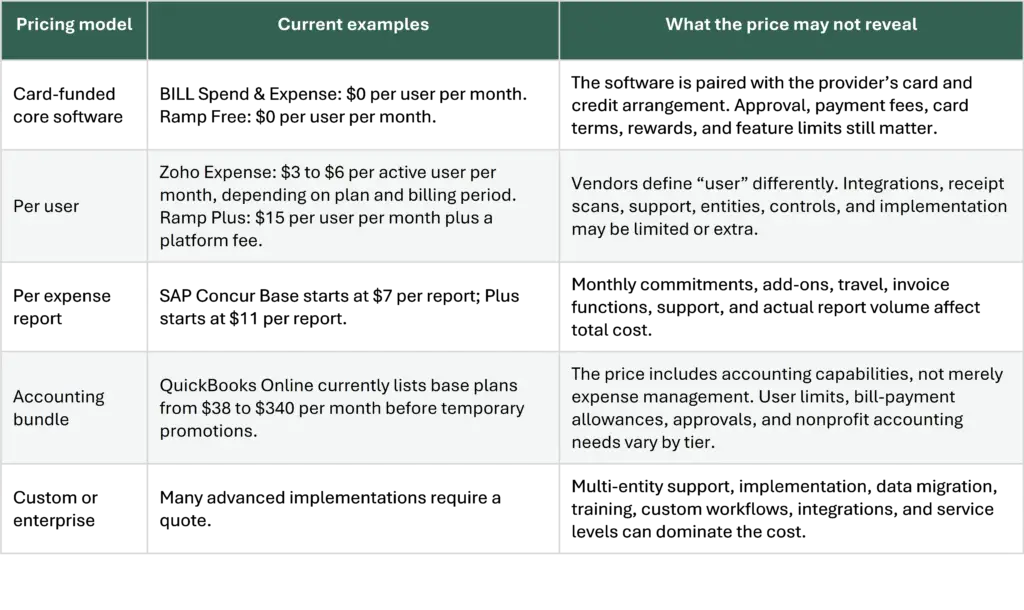
The $0 model is real. Both Ramp and expense management platform Bill Spend & Expense offer expense management software plans at $0 per user. As Bill’s Senior Product Marketing Manager Ethan Annis told ACRE, “The traditional advice was to wait until you could justify the software line item in the budget. That calculus has changed now that free expense management tools exist…When the software costs nothing, the question stops being ‘can we afford this?’ and becomes ‘do we have enough spending activity for controls to matter?’”
The free expense management tools exist because those companies make money from a portion of the transaction fee merchants pay when the card is used. What all do you get for your $0 is a question you’ll want to ask. As is often the case, direct cost comparisons can get tricky.
BILL’s current pricing page confirms that its Spend & Expense software has no subscription or per-user fee, while its AP and AR products are paid subscriptions and some payment methods carry transaction fees. Credit lines are subject to approval. Ramp offers free and per-user pricing plans, stating that the free plan is best for smaller teams and includes some AP, travel & expense, and other features. The priced tier offers more features in those categories.
The same cost-comparison challenge applies across the market. Zoho Expense, for example, lists plans from $3 to $6 per active user, while SAP Concur starts at $7 per expense report. Their pricing is based on different factors, further complicating cost comparison.
A nonprofit may want to calculate the cost of the operating arrangement it will actually use, including implementation, paid integrations, transaction fees, support, training, staff time, card terms, and the cost of eventually exporting or moving its data.
Rewards or cash back should be evaluated separately, after confirming that the underlying controls and workflow meet your nonprofit’s individual needs.
Saving Money and Time
Spend management software can not only help you clean up messy manual processes, industry sources say it can also save you money and a lot of time. Dickson noted that “An expense-management platform can reduce costs in three main ways: less manual finance work, fewer out-of-policy or duplicate purchases, and less time spent chasing receipts, correcting coding, and reconciling transactions at month-end. It can also improve visibility into recurring spend and vendor payments, which helps teams spot unnecessary or unapproved costs sooner.”
Annis added in a survey of over 100 BILL Spend & Expense users, respondents reported saving an average of 12 hours per month (source) and $10,630 (source) in monthly savings across time, software consolidation, and spend visibility.
A larger lesson about stewardship
A recent Leanademy case study is instructive. The nonprofit being studied was already using Emburse for card-expense reporting and Amazon Business for purchasing. Its LEAN-based improvement project added clearer preauthorization rules, mobile receipt capture, a central dashboard, role-based approvals, bulk processing, checklists, reminders, escalation procedures, and ongoing monitoring.
Leanademy reports that expense-reporting defects declined more than 70%. But the case does not disclose the number of transactions, measurement period, or calculation needed to treat that figure as a benchmark.
The more useful lesson is what changed. The organization did not simply buy software and wait for errors to disappear. It clarified which purchases required advance approval, made it easier to capture receipts, assigned review responsibilities, monitored exceptions, and created a way to follow up when the process was not followed. It helped the organization improve its stewardship practices.
Software can absolutely help improve financial management, but it won’t matter much without solid processes, controls, and oversight in place.
Questions a nonprofit should ask before buying
- Which problem are we solving: cards, reimbursements, receipts, approvals, vendor bills, budget visibility, or all of them?
- Can the system code expenses using every account, program, grant, fund, location, and restriction we need?
- Exactly what data and documents move to and from our accounting system, how quickly, and in which product tier?
- Can approval authority and card access be separated appropriately, including when a small staff requires compensating review controls?
- Can occasional users, volunteers, and board members submit documentation without paid full-user licenses?
- What happens when a sync fails, a receipt is missing, a transaction must be split, or a cardholder leaves?
- What will we pay for the expected number of users, reports, payments, integrations, entities, support needs, and implementation services?
- Can we export complete transaction data, approvals, receipts, and audit history if we change systems?
- Could cash back or other rewards meaningfully offset the cost of the software itself?
These questions are especially important for organizations receiving federal awards. Federal rules require records that identify the source and use of award funds, source documentation, comparison of expenditures with budgets, and effective controls over funds and assets. Software can support those requirements, but purchasing a product does not itself establish compliance.
Start with the workflow, not the demonstration
Before scheduling demonstrations, map one ordinary purchase from request through approval, payment, receipt collection, coding, reconciliation, and reporting. Note where work stalls, information is re-entered, documentation disappears, or oversight occurs too late. Then ask each provider to demonstrate that exact scenario with the organization’s real accounting dimensions and approval rules.
A limited pilot can be more revealing than a polished sales presentation. Test one program, a few cardholders, or one reimbursement workflow. Measure missing documentation, correction time, approval delays, month-end effort, and staff experience before and after the pilot.That’ll give you the information you need to make your choice.
For more resources to help your charitable organization or association reduce purchase expenses and excess operating costs in new and meaningful ways, visit Administrative Cost Reduction Experts at https://ACREcutsCosts.com
.
Sources and pricing references
- BILL pricing and Spend & Expense features, accessed September 15, 2026.
- Ramp pricing and feature comparison, accessed September 15, 2026.
- Zoho Expense pricing, accessed September 15, 2026.
- Expensify pricing, accessed September 15, 2026.
- SAP Concur pricing, accessed September 15, 2026.
- QuickBooks Online expense and plan information, accessed September 15, 2026.
- Federal financial-management requirements in 2 CFR 200.302.
- Leanademy case study, supplied as a PDF by ACRE.
- Written responses to ACRE from Ethan Annis of BILL and Ben Dickson of Ramp, September 2026.
What, If Anything, Do Nonprofits with High Overhead Ratios Have in Common?
A Look at Nonprofits Operating with Administrative Expense Ratios Higher than 25%
Read The Full Article
By Craig Price
Founder
Administrative Cost Reduction Experts (ACRE)
In an earlier post, I mentioned that I wanted to look more closely at nonprofits reporting administrative expense ratios above 25%. I was curious to know what, if anything, those organizations might have in common.
What followed was an AI-led research and analysis project (so insert here all the disclaimers about the potential for AI to make mistakes.) But the purpose wasn’t to scientifically identify degrees of correlation. It’s just to surface interesting commonalities or absence of commonalities.
Using data pulled from CauseIQ, the study looked at 17,480 comparable Form 990 filers with revenue between $500K and $10M and administrative expense ratios above 25% (and insert here all the disclaimers about the lack of standardized data when studying 990s.) Of that group, the higher ratios appeared most often among smaller, newer and lightly staffed organizations. The nonpprofits with the highest ratios also reported less program-service revenue. Yet they did not look more financially distressed, based on the figures examined.
Smaller staffs corresponded with higher ratios
Organizations reporting no employees had a median administrative expense ratio of 39.7%. Those reporting at least 51 employees had a median of 31.1%. The relationship remained stable within each revenue band, so revenue alone did not account for the gap.
The difference could be partly due to fixed administrative costs spread over a smaller expense base. It could also reflect volunteer-led, grantmaking, religious or asset-holding organizations that do not resemble labor-intensive service providers. They type of nonprofit undoubtedly has a lot to do with where one will fall on the overhead ratio scale.
Age showed a similar but weaker pattern. Organizations approximately 10 years old or younger had a median ratio of 37.5%, compared with 32.6% among those 26 to 50 years old. Start-up costs and limited scale are plausible explanations, but sector and survivorship differences may matter too.
The highest-ratio group was not payroll-heavy
The 2,428 nonprofits reporting ratios of 60% or more had a median of zero employees. More than half reported no employees at all. Their median compensation expense was 20.4% of total expenses, compared with 49.9% among organizations in the 25 to 30% range. So concerns about bloated staff or exceedingly high executive compensation don’t seem to be significant cost drivers for those with the highest overhead ratios.
Professional fees were not a broad contributor either. They represented a median 6.24% of expenses in the 60%+ group and 6.25% in the 25 to 30% group, an almost identical result. Professional fees may matter greatly for a particular nonprofit, but they didn’t generally rise in sync with the administrative ratio.
Higher overhead does not equal financial trouble
The 60%+ overhead group reported a median total margin of 24.8% and 231 days of cash on hand. The 25 to 30% group reported a 5.3% margin and 137 days of cash.
Strong margins and cash could result from a lot of things; prudent reserve building, investment income, grantmaking cycles or unusual timing. They could also reflect resources that were not deployed for current mission activity.
Higher ratios can be persistent
Among 15,913 organizations with at least three usable years of filings, 53% reported ratios of at least 25% in 80% or more of those years. Among organizations currently at 60% or more, 69% met that same level of persistence. For many organizations, then, the ratio would appear to reflect something more enduring than one unusual year.
A lot of factors impact the amount of overhead that nonprofits spend. Number one likely being the type of services they provide. For many organizations, high administrative cost ratios are part-and-parcel of what they do. One of many reasons a nonprofit should not be denied funding opportunities solely because that number is higher than an arbitrarily assigned ceiling.
For more resources to help your charitable organization or association reduce purchase expenses and excess operating costs in new and meaningful ways, visit Administrative Cost Reduction Experts at https://ACREcutsCosts.com
.
From the ACRE Archives



Is Your Budgeting Process Costing You Money?
The many ways nonprofits unintentionally lock in excess spending when they create their budget.
How To Vastly Reduce Credit Card Fees!
You can’t stop accepting credit cards. You don’t want to limit the ways members or donors can pay you. So instead of limiting options, why not expand them?
The Nonprofit Guide To Creating A Cost-Conscious Culture
Demonstrate to current and potential donors and members that your organization is a truly outstanding steward of the money they give.

Lower Cost Health Care Benefit Options For Nonprofit Employers
They don’t offer perfect coverage but for nonprofits that can no longer afford comprehensive employee health benefits, there are options.
How About Zero Credit Card Fees?
Welcome to Zeffy. How the free nonprofit payment processor does it and what It could mean for your nonprofit.